Friday, 24 December 2021

FIUV announces a new Ordo for 2022


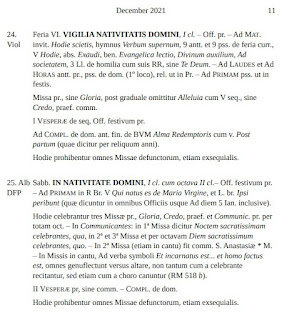
It seems clear that there will be no Ordo for the Traditional Mass from Rome this year: it had been published for a number of years by the PCED and then the CDF.

Accordingly, the Federation has asked Peter Day-Milne to format an Ordo in the same style. It shows the Universal Calendar, with no local feasts. We hope it will be a useful resource. 

It can be downloaded as a pdf here.

We plan to print some physical copies as well, but this will have to wait for the New Year.

Comments and corrections please to secretary@fiuv.org

Support the FIUV by becoming a Friend.

Thursday, 23 December 2021

Canonical Guidance on the Responsa ad dubia


The Federation draws attention to the Canonical Guidance published by the Latin Mass Society (England and Wales) on the Responsa ad dubia published by the Congregation for Divine Worship on Saturday 18th December.

The Responsa can be seen here.

The Canonical Guidance can be seen here.

We will be adding links to translations of the Guidance as they become available.

There is a Polish version here.

Support the FIUV by becoming a Friend.

Monday, 29 November 2021

Mass celebrated for Vladimir Ashkenazy in London

IMG_0039

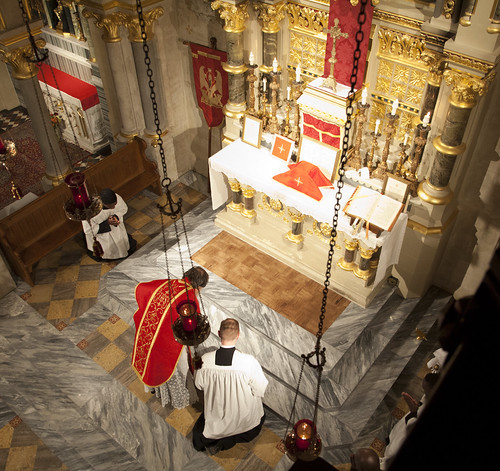
As well as presenting the distinguished conductor and pianist Vladimir Ashkenazy with the De Saventhem Medal, the Federation had a Mass celebrated for the good estate of his family through the Latin Mass Society, on the feast of St Cecelia, the Patron Saint of music. (More about this here.)

It was a Missa Canata, celebrated by Fr Gabriel Diaz Patri, and accompanied by polyphony sung by the Southwell Consort led by Dominic Bevan.

Wednesday, 17 November 2021

Responding to Cardinal Cupich

E14E7798
Mass last Saturday in St Joseph's Bedford: LMS Pilgrimage
in honour of Our Lady of Guadalupe

Cross posted from Joseph Shaw's LMS Chairman blog.

Cardinal Cupich has published a defence of Traditionis Custodes in the Jesuit magazine America. (An earlier article, on Pray Tell, finds a response from Matthew Hazell on Rorate Caeli here.) In this article he argues... well it is actually quite unclear what he is arguing. 

Is he suggesting the TC was a response to the failure of the SSPX to submit to the Holy See after Summorum Pontificum? In which case why are their privileges to give absolution and witness marriages in the old Rite not the target of the Holy See's restrictions, instead of the corresponding rights now denied to priests in good standing in the diocese of Rome?

Is he suggesting, instead, that the problem has been that people have been "promoting" the "antecedent liturgies"? But isn't that exactly what Pope Benedict XVI called for when saying that "it behooves us to ...to give them their proper place"?

Or is he arguing something quite different: that the very existence of an alternative form of the liturgy is a wound in the unity of the Church? In which case his complaint is less against the SSPX, or the Faithful who attend the Usus Antiquior under the bishops, but with Pope Benedict himself.

I have published a response in Catholic World Report. (America declined to let me respond.)

Cardinal Cupich begins the story with Archbishop Marcel Lefebvre, in “the early 1970s”. It is worth noting that by the time the SSPX became headline news, with its canonical suppression in 1975 and unauthorised ordinations in 1976, lay groups had been campaigning for the ancient Mass for more than a decade, and had achieved a symbolic, if limited, concession in Pope Paul VI’s Indult for England and Wales which was signed in November 1971, exactly fifty years ago. It was, similarly, the desire of the Faithful, not of SSPX clergy, which was recognised by Pope John Paul II’s world-wide indult of 1984, which does not mention the SSPX, and these Faithful who are again noted as a motivation for Pope Benedict’s Apostolic Letter Summorum Pontificum.

This is worth emphasizing because, although they share an attachment to the former Missal, the International Una Voce Federation (founded in 1965) and its member associations around the world, and the SSPX, are clearly distinct phenomena, and have suffered quite different fates in recent years. In 2016 Pope Francis gave priests of the SSPX special faculties to hear confessions, and in 2017 he made provision for them to officiate at marriage services. They still enjoy these privileges today. Priests serving the faithful within the structures of the Church, on the other hand, have just been forbidden to do either thing using the older books used by the SSPX in the very diocese of Rome. If Traditionis Custodes is motivated by disappointed hopes for “healing and unity” with the SSPX, it seems to have sadly mistaken its target.

Read it all there.

Support the FIUV by becoming a Friend.

Monday, 15 November 2021

Photos of the Summorum Pontificum Pilgrimage

Edward Pentin has kindly allowed us to use his photos. Here is a small selection; the full set is here.

Monday, 8 November 2021

De Saventhem Medal awarded to Vladimir Ashkenazy, petitioner for the Traditional Mass

Vladimir Ashkenazy; photo by Keith Saunders
To mark the 50th anniversary of the granting of the 'English Indult', the FIUV made contact with the sole living representative of the signatories of the petition to which the Indult was a response: the Russian-born pianist and conductor Vladimir Ashkenazy, one of 57 mostly British figures from the social and cultural elite, many of them non-Catholic.

We are delighted to announce that he has accepted the Federation's award of its rarely-bestowed De Saventhem Medal, for his contribution to the cause of the Traditional Latin Mass.

Among the signatories was the crime-writer Agatha Christie, whose books have sold more copies than any other author, setting aside Shakespeare and the Bible.

Mr Ashkenazy, now 84 and living in retirement in Switzerland, was one of the younger signatories back in 1971, since the focus was on people at the pinnacles of their careers. One signatory, the distinguished classicist Sir Maurice Bowra, President of the British Academy, died a few days before the petition was published in the Times in July 1971, at the age of 73.

The signatories included many of the most senior Catholics in the country, such as the Duke of Norfolk and a prominent judge, Lord Russel of Killowen; Catholic and non-Catholic cultural figures such as Kenneth Clark, the Director of the National Gallery, Cecil Day-Lewis, the Poet Laureate, and Graham Greene; and academics who were household names, such as the historian Sir Harold Acton and the philosopher Dame Iris Murdoch.

Vladimir Ashkenazy is a worthy representative of this distinguished group. He experienced Soviet Communism, but was able to make his life in the West, in England, Iceland (his wife's homeland), Greece, Germany, and Switzerland. Like many of men and women of artistic sensitivity, he saw the significance of the ancient Catholic liturgy, and understood the threat to it as a threat, as the petition text expressed it, to world culture.

In accepting the award, he wrote:
'Dr Erich de Saventhem: Pro merito magno'

My personal view of the matter is, that it is of great spiritual value and importance that the more ancient Latin Catholic Liturgy, with its associated cultural and musical traditions, be preserved for all those who are concerned with strengthening, or at least maintaining, our connection with the Divine; the ancient liturgies, be they Catholic or Orthodox (I am baptized in the Russian Orthodox Church) are, by default, bound to represent a much purer spiritual relationship with Christ in particular, and with the world in general, than do, to quote Dr. Erich Vermehren De Saventhem: " the flat, prosaic, philistine or delirious liturgies which will soon overgrow and finally smother even the recently revised rites..."

Being a musician, I am fully in agreement with the idea that the ancient/traditional Roman Catholic Mass will have inspired a plethora of invaluable artistic achievements over the ages: mystical works, poetry, philosophical treatises, musical works of genius, magnificent edifices, wonderful paintings, incredible sculptures, and even the construction of marvellous musical instruments like the organ and the piano!

There is a discussion of the significance of the petition and of the involvement of Agatha Christie on the Catholic National Register, and of cultural figures including Vladimir Ashkenazy on the 1P5  blog respectively.

More about the 1971 petition, its organiser Alfred Marnau, and other petitions for the same cause, can be seen here.


Support the FIUV by becoming a Friend.


Saturday, 6 November 2021

Letter between Cardinal Nichols and the Prefect of the CDW

Letters between the Cardinal Archbishop of Westminster, England, Vincent Nichols, and the Prefect of the Congregation for Divine Worship, Archbishop Arthur Roche, have been made public, first on Gloria TV and then on the 1P5 blog.

FIUV President Joseph Shaw comments on them on 1P5:

They have been offered to OnePeterFive and since they are now going to be seen by everyone I can comment on them publicly. Some of the contents are a little technical and obscure, but none of it should surprise us, the basic message is positive, and it also gives us a chance to respond to arguments currently being developed to limit what we can do.

Read it all there.

Support the FIUV by becoming a Friend.

Wednesday, 3 November 2021

The FIUV welcomes the Latin Mass Society of Slovakia


The FIUV has formally welcomed LMS Slovakia (Spolok latinskej Omše) as a member. 

They were founded in August 2021, and admitted to the Federation in September.

I had the honour of meeting Mr. Peter Čambál, the President, their Chaplain, Fr Ľubomír Urbančok, and other members of their group in Rome during the Summorum Pontificum Pilgrimage.

Quite a few priests in Slovakia have learnt how to celebrated the Vetus Ordo and the association has already organised a retreat for families and a training event for altar servers. 

By a happy coincidence the association has been founded on the 50th anniversary of the English Indult, a response by Pope Paul VI to an initiative by a native of Bratislava, the capital of Slovakia, Alfred Marnau. If you want to read a Slovakian translation of the story of the 'Agatha Christie Indult' you will find it on their website here.

Support the FIUV by becoming a Friend.

Monday, 25 October 2021

InfoCatolica: Spanish-language interview with the President

IMG_0449
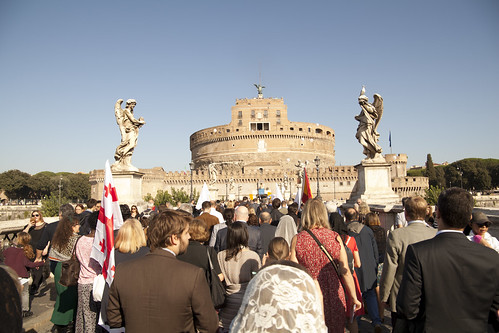
2019 Summorum Pontificum Pilgrimage: procession to St Peters, crossing
the bridge towards the Castel San Angelo

D. Joseph Shaw es Doctor en Filosofía. Tutor titular en el St. Benet’s Hall, de la Universidad de Oxford, es además presidente de la Latin Mass Society de Inglaterra y Gales, asociación para la defensa y promoción de la misa tradicional, y ha sido recientemente nombrado presidente de la Federación Internacional Una Voce (FIUV), en la que previamente había ejercido varios años como secretario. Shaw pertenece igualmente al Consejo organizador de la peregrinación Populus Summorum Pontificum, integrada por sacerdotes y fieles de la liturgia antigua, que todos los años acuden a Roma en la festividad de Cristo Rey según el calendario de 1962. Prolífico autor de numerosos artículos sobre temas litúrgicos, ha sido además editor de los “Position Papers” (informes de situación), que la FIUV publicó, con estudios sobre distintas materias relacionadas con la liturgia romana clásica.

Read it all there.

See the interview in English here.

Support the FIUV by becoming a Friend.

Thursday, 21 October 2021

Tuesday, 12 October 2021

Gregorius Magnus 12, Winter 2021, published

I am pleased to announce the Winter 2021 issue of Gregorius Magnus is available.

Gregorius Magnus 12, Winter 2021, is now available as a PDF, and on ISSUU, optimised for mobile devices.

In this edition:

Reactions to Traditionis Custodes

From members' magazines: Peter Kwasniewski on proclaiming the Gospel to the north; Pope Francis and Dante; Remembering Mgr Richard Soseman; Cardinal Merry del Val.

Features: J.R.R.Tolkien by Robert Lazu Kmita; Traditional walking pilgrimage in Spain.

50th Anniversary of the English Indult; Petitions from 1966 to 1997.


Become a Friend of the Federation and receive Gregorius Magnus by email.

Support the FIUV by becoming a Friend.

Saturday, 9 October 2021

Message from the President, Dr Joseph Shaw

To the Member Associations of the Federation, and all our supporters and friends.

It is with some apprehension that I take up the role of President of the FIUV, in light of my personal limitations, and at a time when the situation of the Church’s ancient Latin liturgy is more difficult than it has been for many years. Yet I do so with confidence in the strength of the Federation, represented above all by our membership and support base. This is larger and more active than it has ever been in our history, and the current difficulties are stimulating further growth.

Over the last decade I have been closely involved in two large-scale projects undertaken by the Federation: the production of the Position Papers on the 1962 Missal, which began to appear individually in 2012 and were published as a book in 2019, and the Report on the implementation of Summorum Pontificum for the Congregation for the Doctrine of the Faith, which we submitted to the Holy See in July 2020. These utilised different aspects of the deep reserves of experience which exist among the Federation’s members and supporters: the Position Papers calling on their intellectual resources, and the Report on their practical knowledge of their local situations. No other organisation could have undertaken either project so successfully, and they demonstrate the Federation’s irreplaceable role in the traditionalist movement.

Friday, 8 October 2021

New President and Officers of the FIUV

Joseph Shaw on the Latin Mass Society's
Walking Pilgrimage to Walsingham, Aug 2021
At the General Assembly held (for the first time) online, on Saturday 2nd October 2021, a new Council and President were elected. The Council subsequently confirmed the Officers.

The outgoing President, Felipe Alanis Suarez (Una Voce Mexico) had served three consecutive terms of office; he remains on the Council as the First Vice President.

The new President is Joseph Shaw (Latin Mass Society, England and Wales); he had previously been the Secretary.

The new Secretary is Christopher Cordeiro (Una Voce South Africa).

The Treasurer remains Monika Rheinschmitt (Pro Missa Tridentina, Germany).

The full Council is listed here.

Support the FIUV by becoming a Friend.

Thursday, 7 October 2021

FIUV Video series

The Una Voce Federation has created a series of illustrative videos that show some of the most relevant aspects of the Traditional Latin Mass (TLM) in order that more people can get to know and appreciate the richness of our Catholic Heritage.

Our YouTube channel is here; they are also collected on this page.

Here are the two most recent. More are planned.

The celebration of Mass ad orientem


Silence in Mass


Support the FIUV by becoming a Friend.

Monday, 16 August 2021

Gregorius Magnus: call for submissions for the Winter edition

The deadline for submissions to the 12th edition of the FIUV magazine, Gregorius Magnus, is 15th September.

See the call for submissions which went out by email here. Previous issues here.

Gregorius Magnus is mostly online-only, but we print a few copies as well.


Thursday, 22 July 2021

Canonical Guidance from the Latin Mass Society on Traditionis Custodes

Cross-posted from the blog of the LMS Chairman,

IMG_0528
The 1962 Mass in the Chapel of the Throne, in St Peter's Basilica, Rome, celebrated by
Bishop Rey of Frejus, France, for the Summorum Pontificum Pilgrimage 2019.


With thanks to Edward Pentin for breaking the story on the National Catholic Register, with some helpful commentary, the Latin Mass Society is pleased to present the fruits of our consultations with a number of Canon lawyers, in a short document available on our website.

We have circulated this a little privately but we believe that it would be valuable to present it to the widest possible audience. It is clear to us that many bishops, priests, and lay Catholics, are finding it difficult to see exactly what the force of the Apostolic Letter might be.

It is our hope that the arguments contained in this Guidance will commend themselves to careful readers from across the spectrum of opinion, and contribute to a calm and reasoned discussion. 

Key points from the Guidance:

*Traditionis Custodes does not abrogate the 1962 Missal (otherwise it could not allow it to be said in certain circumstances).

* It follows that it is not the right of priests to celebrate it that is at issue--this remains intact--but the public exercise of this right, which is a matter of regulation by the local bishop.

* The right of priests to celebrate privately, to say the older Office, to celebrate the other sacraments, to use the older Rituale: all these are unrestricted by Traditionis Custodes.

* The restrictions mentioned in Article 3, notably on the use of parish churches, only apply in the case of 'authorised' 'groups', such as came into existence in the course of the formal application of Summorum Pontificum, or are served by a 'personal parish'. 

* Although preists need permission from the bishop to celebrate the 1962 Missal, with this permission, and outside the context of a formalised 'group', he may do so without the restrictions of Art 3: for example, in a parish church.

*It would also follow that there need be no difficulty allowing the 1962 Missal to be used for special occasions such as pilgrimages. 

See the document in full here.

Monday, 19 July 2021

Official Statement of the Fœderatio Internationalis Una Voce regarding the Motu Proprio «Traditionis Custodes»

The International Federation Una Voce (FIUV) is the worldwide organization of lay faithful attached to the celebration of the Mass according to the Editio Typica 1962 of the Roman Missal, known until now as the Extraordinary Form of the Roman Rite, Usus Antiquior, or simply the Traditional Latin Mass.

Since its foundation in 1965, the FIUV has developed its activities in obedience to and in harmony with the Holy See, where we have always been received with cordiality and openness.

On 16th July 2021, Pope Francis published an Apostolic Letter given motu proprio, Traditionis Custodes, which establishes tight restrictions and limitations on the celebration of the Traditional Latin Mass.

The International Federation cannot fail to note that the motivation for the new Apostolic Letter, as stated in the accompanying letter of the Reigning Pontiff derives from the alleged attitudes and words of those of us who choose the Traditional Mass, as reported by some Bishops to the Holy See, which involve a «rejection of the Church and her institutions in the name of what they consider the "true Church."» In addition to an «instrumental use of the Missale Romanum of 1962, which is increasingly characterized by a growing rejection not only of the liturgical reform but of the Second Vatican Council, with the unfounded and unsustainable claim that it has betrayed Tradition and the "true Church."»

Both the characterization of Catholics attached to the Traditional Mass, and the harsh new restrictions on it, sadden us greatly. It is our experience, as representatives of groups of the faithful, that what primarily attract people to the spirituality of the Traditional Mass are not the theological or pastoral discussions of the past, but respect for the Sacred, and the sense of the continuity of Tradition, which does not remain as a mere aspiration, but is lived daily in the venerable rite that has developed slowly through centuries and has never been abrogated.

Certainly, as with other groups of the Faithful, there is no absolute homogeneity in the opinions and attitudes of those attached to the former Missal. But precisely in their desire to assist at this Mass within the framework of their Dioceses and parishes, these Catholics implicitly express their recognition of the true Church, cum Petro et sub Petro.

Finally, as sons and daughters of the Church we wish to express our sadness over the restrictions on our ability to continue to nourish our spiritual lives using parish churches, as any Catholic would like to do. If there is one thing we fervently desire, it is to be able to live a normal life without being forced to use hidden or inaccessible spaces.

We believe that the beautiful spiritual fruits of this Missal should be shared, and we pray that we can be instruments of God inside and outside the Church.

The International Federation is deeply grateful to each of the Bishops who are generously providing for the faithful attached to the ancient Mass in their dioceses and to the Priests entrusted with the care of their souls.

Una Voce groups all over the world are united in prayer, as always, with their bishops and with the Pope.

Many of the faithful look to us to make their desires known, particularly in Rome, in a way which combines a sincere respect for the Universal Church and the Holy Father, with a love of the Traditions which are ultimately inseparable from them. We are committed to this task, which we and our predecessors have undertaken for more than half a century. 

Felipe Alanis Suarez
President
18 of July 2021

Monday, 12 July 2021

Cardinal Zen on the value of the Extraordinary Form

Joseph, Cardinal Zen posted this on his personal website, in Italian, and tweeted it on 12th June 2021. 

Translation by Diane Montagna: reproduced with permission.

------------------------------

What’s the harm in making the Extraordinary Form of the Roman Rite accessible to all?


I have read in the news quite worrying reports about possible restrictions to the celebration of the Tridentine Mass (what we now call the Extraordinary Form of the Roman Rite). I want to make it clear that I cannot be considered an extremist of this liturgical form and that I have worked actively, as a priest and as a bishop, for the liturgical reform after Vatican II, also by trying to curb excesses and abuses, which unfortunately have not been lacking in my diocese. So, I will not be accused of factiousness. But I cannot deny, in my experience in Hong Kong, the great good that has come from the motu proprio Summorum Pontificum and from the celebration of the Tridentine Mass. There is a faithful group here that, for decades, has participated in this form that comes to us from the liturgical riches of our Tradition, a group that has never created problems for the diocese and whose participants have never questioned the legitimacy of the renewed Mass. Many young people have passed through the community that participates in the Extraordinary Form in Hong Kong, and through this Mass they have rediscovered the sense of adoration and reverence that we owe to God, our Creator.

I have worked for the liturgical reform, as I said, but I cannot forget the Mass of my childhood. I cannot forget when, as a child in Shanghai, my father, a devout Catholic, took me to Mass every day and on Sundays made me attend five Masses! I felt such reverence, I was so fascinated (and still am!) by the beauty of Gregorian Chant, that I think that experience nourished my vocation to the priesthood, as it did for so many others. I remember the many Chinese faithful (and I don’t think all of them knew Latin...) participating in these liturgical ceremonies with great enthusiasm, just as I can now witness in the community attending the Tridentine Mass in Hong Kong.

The Tridentine Mass is not divisive; on the contrary, it unites us to our brothers and sisters of all ages, to the saints and martyrs of every age, to those who have fought for their faith and who have found in it inexhaustible spiritual nourishment.

Translation by Diane Montagna


Saturday, 10 July 2021

Cardinal Sarah on the importance of Summorum Pontificum

A series of Tweets sent but Robert, Cardinal Sarah, @Card_R_Sarah, at 12pm on 8th July 2021 (translated from French).

History will remember Benedict XVI, not only as a great theologian but also as the Pope of Summorum Pontificum, the Pope of liturgical peace, who built an ecumenical bridge with the Christian East by means of the Latin-Gregorian liturgy.


He will be remembered as the Pope who had at heart the desire to find again the Christian roots and unity of Europe. He opposed meaningless secularism [laicisme] and the disintegration of European culture.


Following the Motu Proprio Summorum Pontificum, despite difficulties and resistance, the Church embarked on a path of liturgical and spiritual reform, which, though slow, is irreversible.


Despite intransigent clerical attitudes in opposition to the venerable Latin-Gregorian liturgy, attitudes typical of the clericalism that Pope Francis has repeatedly denounced, a new generation of young people has emerged in the heart of the Church.


This generation is one of young families, who demonstrate that this liturgy has a future because it has a past, a history of holiness and beauty that cannot be erased or abolished overnight.


The Church is not a field of battle where one plays to win by trying to harm the spiritual sensitivity of ones brothers and sisters in the faith.


As Bendict XVI said to the French bishops: “In the Church there is room for everyone,” because we know how to treat each other with respect and live together, praising the Lord in His Church and remaining in the one true Faith.


The liturgical crisis led to the crisis of faith. In the same way, respect for the two forms of the Latin liturgy, ordinary and extraordinary, will imbue us with a missionary impetus for evangelisation, and we will finally be able to escape of the “tunnel of crisis”.

Wednesday, 7 July 2021

Reactions to the FIUV advert in La Repubblica

I gather together here some news and comment reactions to the FIUV advert: this post may be updated. In terms of the news cycle, the fact that it appeared on the day of Pope Francis’ admission to hospital must have dampened responses. (Please pray for Pope Francis, in true meantime.)

In advance of the Federation’s advert, the most comprehensive report of the rumours about possible changes to Summorum Pontificum came from Diane Montagna in The Remnant.

In English, our announcement of the advert was cross-posted directly on the Rorate Caeli blog.

The first report seems to have been on the Catholic News Agency and Gloria TV.

Church Militant (Jules Gomes) picked it up with a quote from FIUV Secretary Joseph Shaw:

Shaw urged bishops and priests with concerns about the TLM to "come and meet the congregations attending these Masses and the young people and families who have been inspired to live their faith more deeply by this liturgical form." 

So did Robert Moynihan in Inside the Vatican: 

Clearly, this is an attempt to change the terms of the debate, terms which have been unfairly forced upon “traditionalists” by many of their “modernist” critics.
Catholics who love tradition, especially in the liturgical realm, do not love tradition in the way the modernists claim they do, Una Voce is saying.
No, they do not love the old Mass out of a kind of “sclerotic, fearful grasping for the stuffy securities of the past” in a time of change, but rather because, in this very time, in the 2020s, the old ways and old words of the traditional liturgy have somehow begun to seem “newer” than the words of the 1960s.
This is a critical point.
In fact, it is the decisive point.
What this appeal is really saying is that the old Mass, in its venerable antiquity, rooted in prayers and hymns from the very first centuries of the Church, actually seems “newer,” “fresher,” “more alive” than many of the prayers of the “new Mass,” which, 50 or 60 years later, because rooted in the trendy, time-bound certainties of that age, is starting to seem “old.”

LifeSiteNews published an article by Joseph Shaw on the advert and the threat to Summorum Pontificum, and a follow-up article on the issue of concelebration,

The Catholic Herald (which may be paywalled depending on where you are) has a news article taken from the Catholic News Agency and comment piece by its US Editor David Mills, which is worth reading. Mills writes: 

The apologists for suppression claim that the people who want the old Mass are divisive. If that is true, and it is sometimes, the obvious answer is to remove the reason for their alienation. Extend to them the care, and the concessions, you extend to other marginal groups. Some will remain cranky and disgruntled, but the Church has room for the cranky and disgruntled. 
The apologists also claim that only the very old and maladjusted young people want it. That’s wrong as a matter of fact, but even if it were true, why not give the elderly (who deserve our deference) and the maladjusted (who deserve our care) what they want and need? It hurts no one and it clearly helps many.

In German, it was reported by the website Summorum-Pontificum.de, and elsewhere:


Sunday, 4 July 2021

FIUV Statement in La Repubblica


The Una Voce Federation has taken out an advert in the mass-circulation Italian daily newspaper La Repubblica, appearing today, Sunday 4th July.

The English text is as following (for other languages see here):

Living the faith, living the future:
The Extraordinary Form of the Roman Rite
Declaration of the International Federation Una Voce

The International Federation Una Voce (FIUV), founded in 1965, brings together associations of the lay faithful attached to the Extraordinary Form of the Roman rite (the Traditional Latin Mass).

In 2007, the Apostolic Letter Summorum Pontificum recognised the vitality of the traditional liturgy, the freedom of priests to celebrate it, and of the faithful to request it. This has led to an ongoing increase in the number of celebrations of the ancient Latin Mass, and of its spiritual fruits.

During 2020 the FIUV conducted a worldwide survey of the faithful on the implementation of Summorum Pontificum. From this survey, which included results from 364 dioceses in 52 countries, we found:

    The ancient Latin Mass is deeply appreciated by groups of faithful of all ages, especially families with children, young people and converts, found in all social and cultural environments, on all continents and in an ever increasing number of countries.

• In many areas the increased availability of this Mass has favoured the normalisation of relations between the faithful attached to it and their bishops, relations increasingly characterised by mutual understanding and respect.

Nevertheless, we have noticed that, contrary to the previous policy of the Holy See, there are still people within the Church, including some bishops, who would like to see the Extraordinary Form of the Roman rite explicitly suppressed, or subject to further restrictions. For this reason, the FIUV, in view of the faithful who adhere to the Latin Mass, feels the duty to express its opinion, encouraged by Pope Francis' exhortations to the members of the Church to use parrhesia with the necessary humility.

The growth of interest in the traditional liturgy is not due to nostalgia for a time we do not remember, or a desire for rigidity: it is rather a matter of opening ourselves to the value of something that for most of us is new, and inspires hope. Pope Francis has characterised the ancient liturgy in terms of a "sense of adoration" (Press conference of 28 July 2013), we can also apply his words to it: a "living history that welcomes us and pushes us forward" (Evangelii Gaudium 13).

Today we only wish to be part of that "great orchestra" of "unity in variety" which, as Pope Francis said (General Audience of 9 October 2013), reflects the true catholicity of the Church. The Apostolic Letter Summorum Pontificum continues to transform the conflicts of the past into harmony: long may it to continue to do so.

Felipe Alanis Suarez, President                                                                                        www.fiuv.org

Ends

Some details from the international survey are set out in here.


Wednesday, 2 June 2021

Summorum Pontificum Congress

 The Fœderatio Internationalis Una Voce is happy to invite you and all interested people to the forthcoming Summorum Pontificum Congress to be held in the city of Guadalajara, México, and transmitted real-time through videoconferencing systems.

More information and tickets on the Event's official web page: 

https://summorumpontificum.mx/


Friday, 28 May 2021

New article on mitigating infection risk in the liturgy

Sergey Budaev, "Safety and Reverence: How Roman Catholic Liturgy Can Respond to the COVID-19 Pandemic" Journal of Religion and Health (2021), published 24th May 2021.

Among many interesting observations of this article, which cites a great many studies, is that while reception on the tongue does not appear to be more dangerous than reception in the hand, reception kneeling is clearly preferable to reception standing. We reproduce a key passage below; the whole article can be read here (or download the pdf here).


The Holy Species used in the Latin Rite is nearly dry and therefore is likely to have low adhesion of outside particles, further reducing the infectious risk. While receiving the Holy Bread, the communicant normally extends the tongue forward, requiring to hold breath for a while. This reduces possible respiratory output. The traditional manner of receiving Communion on the tongue is therefore unlikely to incur a high risk of infection transmission.

Traditional reverent practice of the Catholic Church incorporates additional elements making it even less risky in the current COVID-19 pandemic. The kneeling position of the faithful while receiving the Host would provide spatial distancing about 50 cm (Fig. 1a): the communicant’s face is located at the level of the chest of the Eucharistic Minister. Provided the communicant stays silent, uses nasal breathing, and the duration of the interaction is short (very few seconds), this would not incur a high risk to the Eucharistic Minister (usually the priest whose safety is prioritized, see above). Furthermore, reduced verbal response of the communicant directs the droplets and aerosol towards the chest of the Minister, which is by far a lower risk than in the face.

Monday, 3 May 2021

Walking Pilgrimages in Spain and England

Although the Chartes Pilgrimage will not be taking place as normal in 2021, a victim in part of its taking place relatively early in the year as we emerge from epidemic restrictions, I'm delighted to bring to a wider public information about a traditional walking pilgrimage in northern Spain, 24th to 26th July, 2021, which everyone should be able to join.

I should also mention that the the Latin Mass Society's annual walking pilgrimage to Walsingham is also open for booking. The dates for this are 26th to 30th August. See here for information and registration.

Nothing will make you feel like a human being and a Catholic again quite like participation in a three-day walking pilgrimage!

Here is more information about the Spanish pilgrimage, which has the support of Una Voce Seville.

Tuesday, 30 March 2021

Gregorius Magnus 11

The latest edition of Gregorius Magnus is now available, for Spring 2021.

Gregorius Magnus 11 pdf download


It includes a report on the events in Rome last October, in place of the usual Summorum Pontificum Pilgrimage.

It also includes a key passage from the French Bishops' summary report to the Congregation for the Doctrine of the Faith on the implementation of Summorum Pontificum, in an English translation published for the first time.

As usual it also includes translations of articles from the quarterly magazines of Una Voce France and Pro Missa Tridentina of Germany, as well as an article from the Latin Mass Society's Mass of Ages, and news and reflections first published here, from Croatia, Romania, and Poland.

It is free to download as a pdf, or to view on the ISSUU website and app for mobile devices.

Tuesday, 9 February 2021

Statment on the Report of the French Bishops' Conference

 Foederatio Internationalis Una Voce:
Statement on the Report of the French Bishops’ Conference (CEF) 
on the Implementation of Summorum Pontificum


The FIUV has become aware of a document, in the public domain, containing a summary of the responses made by French bishops to the questionnaire sent to them by the Congregation of the Doctrine of the Faith, on the subject of the implementation of the Apostolic Letter Summorum Pontificum. Although this document does not appear to have been intended for publication, its authenticity has not been denied, and a reaction to it seems necessary.

We note first that the document adopts a consistently hostile tone towards the ancient Latin liturgical tradition, to the priests who celebrate it, and to the faithful who attend it. This has understandably caused considerable hurt among French Catholics attached to this tradition. The document does not speak, on behalf of the bishops of France, about these sons and daughters of the Church with the words of a shepherd and father. In the words of Una Voce France, we do not find

… the slightest trace of empathy, cordiality, or ‘heart’ in them as they say in one place. Instead, we find contempt, at best indifference, towards those narrow-minded beings, without theology, without charity, that are the faithful to the ancient Latin Mass. A Mass that so many generations followed, and from which they nourished their faith ... which is ours today.[1]

Una Voce France statement on the French Bishops' Conference report on Summorum Pontificum

Below is the statement of Una Voce France with an English translation; it can be seen in French on their website here.

The document of the French Bishops' Conference referred to can be seen in French here.

Summary of the results of the Consultation on the application of the Motu proprio Summorum Pontificum by the CEF
 (Conference of Bishops of France)

La Conférence des Évêques de France a publié une « Synthèse des résultats de la Consultation sur l’application du Motu proprio Summorum Pontificum demandée par la Congrégation pour la Doctrine de la Foi en avril 2020. Le sujet nous concerne et nous tient même à cœur. Nous aimerions vous faire part de notre opinion…

The Conference of Bishops of France published a “Summary of the results of the Consultation on the application of the Motu proprio Summorum Pontificum” requested by the Congregation for the Doctrine of the Faith in April 2020. The subject concerns us and is even close to our hearts. We would like to give you our opinion...

Les « experts » et « secrétaires » de la Conférence Épiscopale de France (C.E.F.) ne déçoivent décidément jamais ! Comme le précise un bon ami lettré, quand ils traduisent les encycliques, ils sont les seuls au monde à saboter le travail, traduisant Spe salvi par « Tous sauvés », et incapables d’imprimer correctement les deux mots grecs de saint Paul que cite Fratelli Tutti : chrêstotês et agathôsunê (tous deux désignent la bonté).

The “experts” and “secretaries” of the Episcopal Conference of France (C.E.F.) never disappoint! As a good friend with a good knowledge of Latin and Greek put it, when they translate the encyclicals, they are the only ones in the world to sabotage the work, translating Spe salvi as "All saved", and unable to print correctly the two Greek words of Saint Paul quoted by Fratelli Tutti: chrêstotês and agathôsunê (both designate goodness).